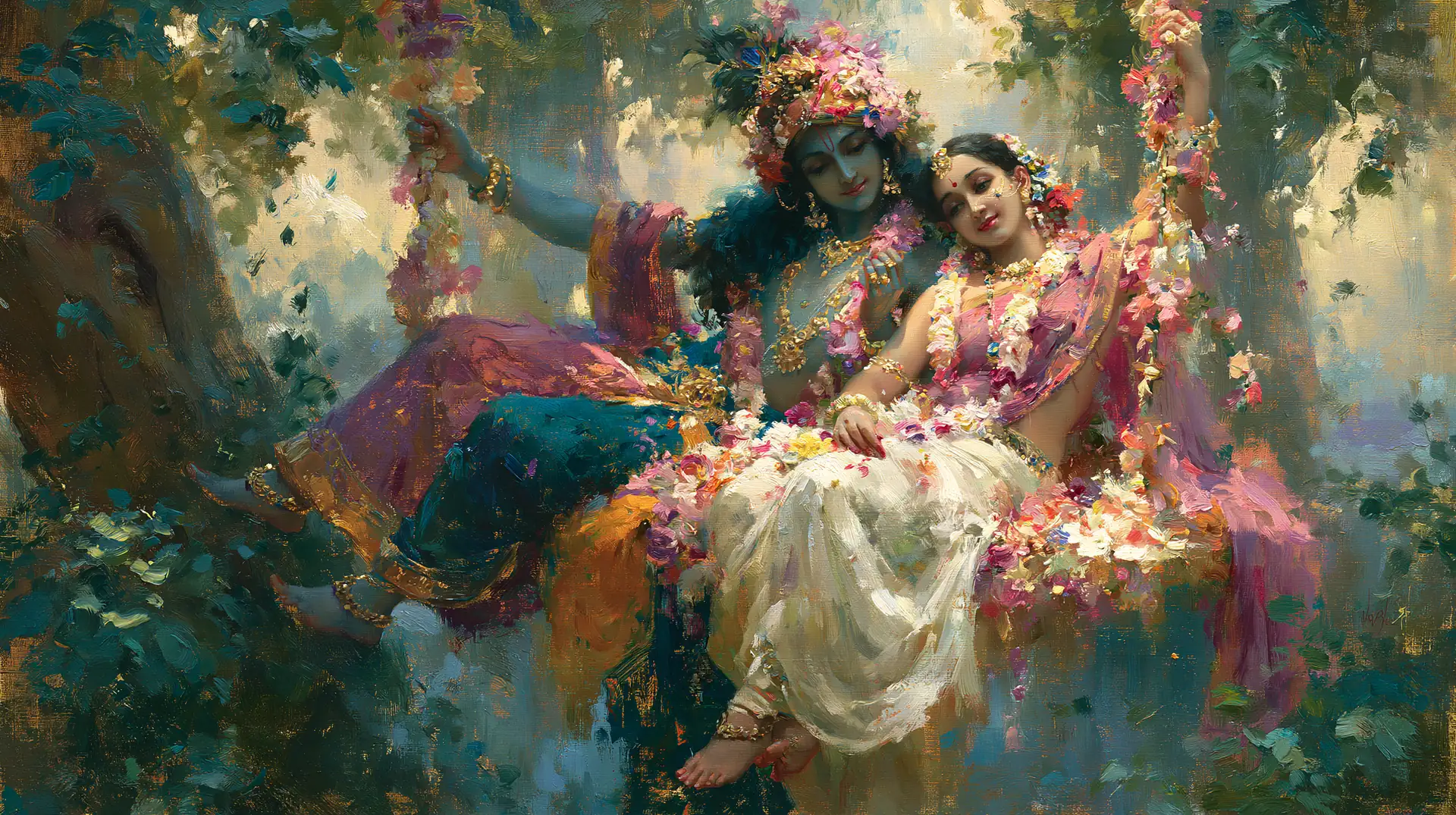
The child in the courtyard of Ayodhya
Maṅgal Bhavan Amaṅgal Hārī
Ramcharitmanas, Bal Kand (Tulsidas)
मंगल भवन अमंगल हारी । द्रवहु सु दसरथ अजिर बिहारी ॥
maṅgala bhavana amaṅgala hārī dravahu su dasaratha ajira bihārī
Word by word
- maṅgala bhavana
- the abode of auspiciousness
- amaṅgala hārī
- the remover of inauspiciousness
- dravahu
- melt with kindness, be gracious
- su
- that beautiful one
- dasaratha ajira
- in Dasharatha's courtyard
- bihārī
- the one who roams and plays
Where it comes from
This is a mangalacharana — an auspicious opening — from the Bal Kand of the Ramcharitmanas, Tulsidas's sixteenth-century retelling of the Ramayana in Awadhi, the language ordinary families spoke. It is not Sanskrit, and that is part of its story: Tulsidas wrote the Manas so that the Lord's story would live in the mouth of every household, not only in the learned. This couplet opens countless kathas, satsangs, and family recitations to this day.
What it means
The couplet holds the whole scale of bhakti in two lines. The first line is cosmic: Lord Ram is the very home of all blessing and the undoing of all harm. The second line is domestic: he is a small boy playing in his father's courtyard in Ayodhya. Tulsidas puts the two lines together on purpose. The Lord of the universe is also the child you could watch from a doorway — and it is the child the verse asks to be gracious.
Reflections
The tender word is dravahu, which means something like melt. The prayer does not ask the Lord to act, grant, or destroy. It asks him to soften toward us, the way an adult's heart gives way at the sight of a child — or a child's does at the sight of home.
This is the genius of the bhakti poets: they collapsed the distance. You do not need philosophy to love the boy in Dasharatha's courtyard. You only need to have loved a child, or been one. Tulsidas opens the door that low so that everyone can walk in.
Sing it before a katha begins and listen to the room settle. Elders who have heard it ten thousand times still close their eyes at bihari. Some verses are not recited so much as returned to, the way one returns to a courtyard from childhood.