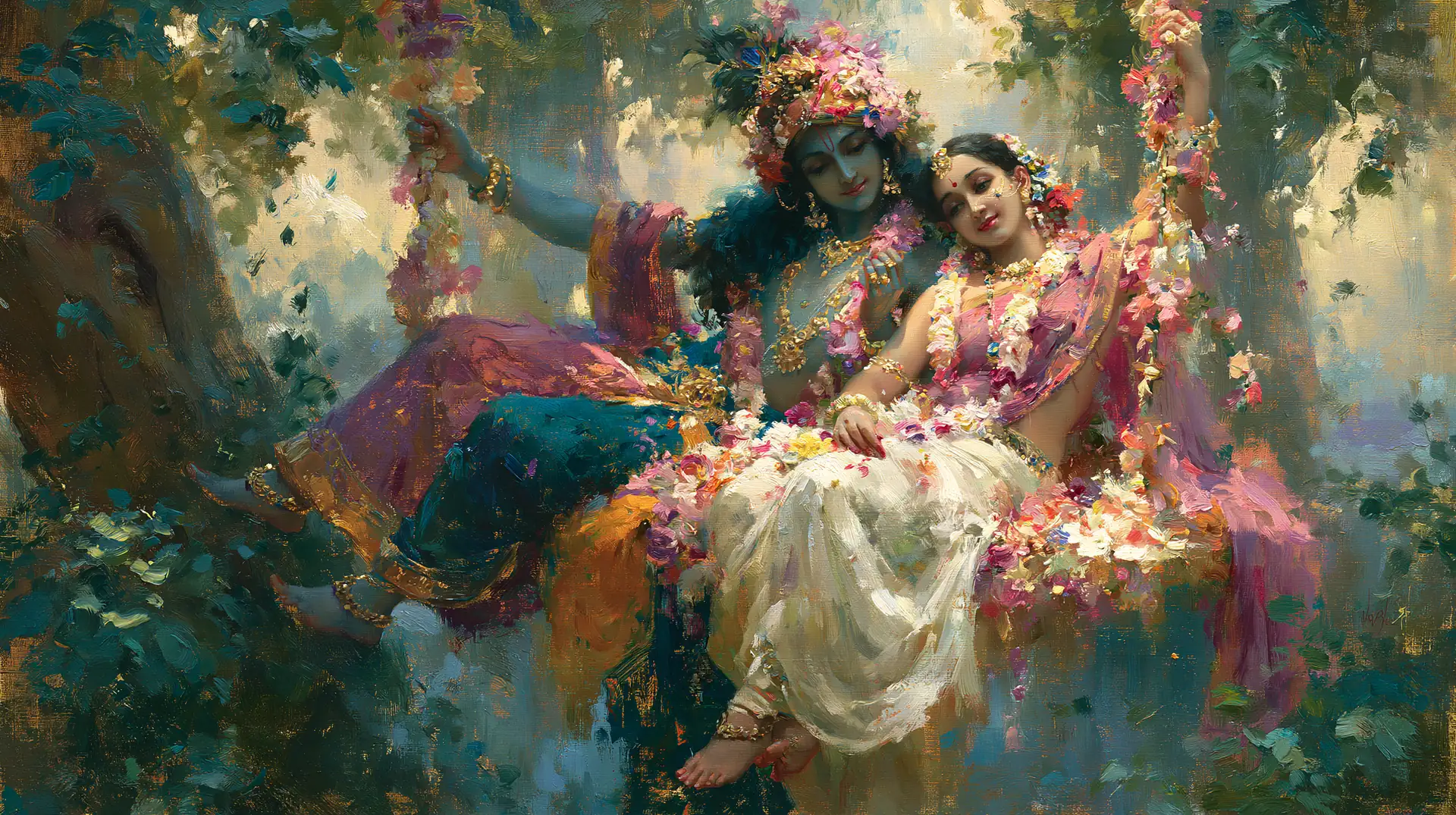
Love that argued with death, and won
Savitri and Satyavan
The wife who followed death
Mahabharata, Vana Parva
Told that the man she has chosen will die in one year, a princess marries him anyway — and when death keeps the appointment, she follows Yama himself down the road, out-thinking him boon by boon until he must hand her husband back.
The choice
Savitri, only child of a king, was so radiant and so formidable that no prince dared court her, so her father sent her to find her own husband. She returned from the forests having chosen Satyavan — a prince by birth, but living in exile in a hermitage, cutting wood to care for his old blind father. She had chosen character over circumstance, precisely.
The sage Narada, present at her homecoming, turned grave. Satyavan is flawless, he said — and he will die one year from today, to the hour. Choose again. Savitri's answer settled the matter and revealed the woman: a heart chooses once. Whether his life is long or short, I have chosen. She married Satyavan and put away her silks for the bark cloth of the hermitage, and told no one what she carried: the date.
The appointed day
For a year she served her husband's family and watched the calendar the way only she could watch it. Three days before the end she took a fast and stood in prayer, day and night. On the morning itself, when Satyavan shouldered his axe for the forest, she asked, for the first time in the marriage, to come along. He laughed and agreed.
At midday, cutting wood, Satyavan swayed, complained that his head burned, and lay down with his head in her lap. And Savitri, who knew the hour to the minute, did not scream or run for help she knew was useless. She held him. Then she saw a figure at the edge of the clearing — dark-robed, red-eyed, noose in hand — and she asked, steadily, who he was. Yama, said the lord of death, come personally for a soul this worthy. He drew the life from Satyavan's body and turned south, the direction of the dead. Savitri rose and followed.
The long argument
Turn back, said Yama; this road is not for the living. Savitri answered with dharma: a wife's place is beside her husband, and to walk seven steps together makes a friendship — surely the lord of dharma will not send a friend away with nothing. Pleased with her words — for Yama is a fair judge before he is a taker — he offered her any boon except the life he carried. She asked sight for her blind father-in-law. Granted. She kept walking.
Twice more this happened. His kingdom restored. A hundred sons for her own father. Each answer wise enough to be granted; after each, she followed still, matching the god stride for stride and speaking of dharma so precisely that death himself slowed to listen. At last, half in admiration and half to be done, Yama offered a final boon — anything but Satyavan's life. And Savitri asked for a hundred sons. Born of Satyavan and no other. The lord of dharma stood caught in his own word: the boon could not be honoured while her husband's soul hung in his noose. Yama looked at the woman who had followed him past the borders of the living — and laughed, and untied it. Take him back, daughter. You have defeated me with righteousness itself.
The return
In the clearing, Satyavan stirred in her lap like a man waking from a strange dream, saying he had dreamt of a dark figure carrying him away. They walked home through the dusk to find every boon already blooming: his father's eyes open and seeing, the lost kingdom calling its family back.
Married women keep her fast to this day — Vat Savitri, tying threads around the banyan under which Satyavan lay — not as superstition, but in salute of the wife who out-argued death and gave nothing away that mattered.
Why it stays with us
Savitri wins by no miracle and no weapon. She wins by knowing dharma more deeply than anyone in the story and refusing to let go — of her choice, of her husband, of the argument itself. Yama grants each boon because each is righteous; she builds her victory out of his own justice, step by patient step. It is the tradition's clearest statement that steadfast love armed with wisdom is a match for anything — including the one appointment no one else has ever talked their way out of.