Is the Bhagavad Gita We Read Today the Original?
No original copy of the Gita survives, and the same is true of almost every ancient book. This is how we know the text has barely changed, traced through the manuscripts that still exist.
Does the original Gita still exist?
Pick up a Bhagavad Gita today, whether in a temple, on your phone, or on a shelf at home, and a fair question follows. How do we know these are the same words that were handed down all those centuries ago? The text was copied by hand for more than two thousand years. It would be reasonable to expect something to have shifted along the way.
The first thing to know sounds worse than it is. No original Gita exists. There is no page written in the author's own hand, anywhere.
That is true of nearly every ancient text. No original manuscript of Homer survives, no first copy of the Vedas, no page in Shakespeare's own hand for most of his plays. Palm-leaf and paper do not last centuries in a warm climate. A manuscript is copied, it wears out, and the copy takes its place. So the real question was never whether we hold the very first copy. We never do, for anything this old. The question is whether the text stayed the same as it passed from hand to hand. For the Gita, the evidence says it did.
What survives: copies across five centuries
What survives is a large family of copies, made in different centuries, in different corners of India, in scripts that look nothing alike. They agree with one another.
One of the oldest still with us is a palm leaf cut in Kerala around five hundred years ago. The letters were scratched into the dried leaf with a stylus, then rubbed with soot so they would show.
 Palm-leaf, 16th-century Kerala. Sanskrit in Malayalam script. (CC BY-SA 4.0, Ms Sarah Welch / Wikimedia Commons)
A few hundred kilometres away and two centuries later, the same verses appear again in Kannada, copied together with a running commentary in the margins. This is how a teaching actually travelled: the verse and its explanation written side by side, in a single scribe's hand.
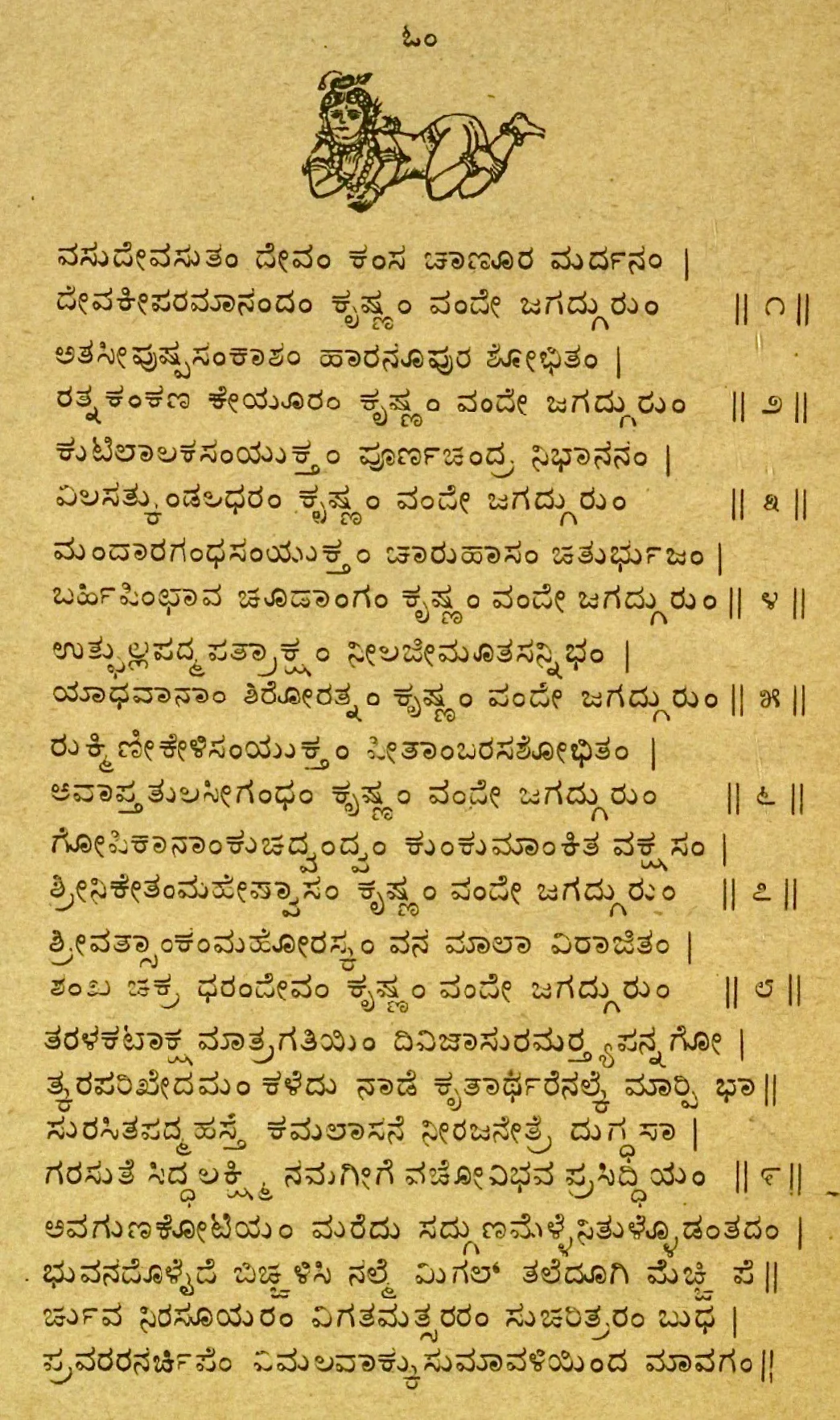 Gita with commentary, 18th-century Karnataka. Sanskrit in Kannada script. (CC BY-SA 4.0, Ms Sarah Welch / Wikimedia Commons)
The same text turns up in Bengali script in the east, in Devanagari on paper (one such copy now sits in a collection near Oslo), and in decorated household copies made to be kept and honoured at home.
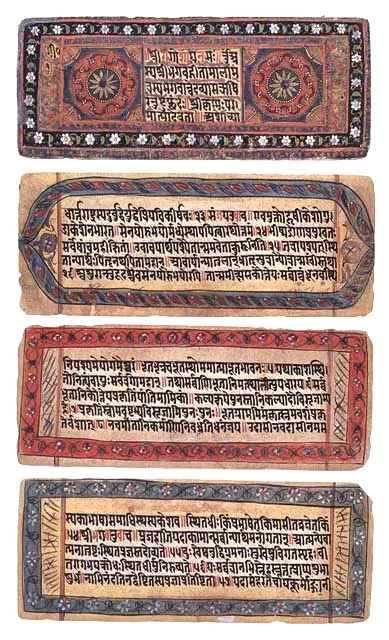 A decorated 19th-century copy from North India. (Library of Congress, public domain)
Why the copies are the proof
No single one of these copies is the original. What makes the case for the Gita is that copies which could never have been coordinated still match.
Consider who made them. A scribe in sixteenth-century Kerala cutting Malayalam letters into palm-leaf. Another in eighteenth-century Karnataka writing Kannada. A third in Bengal. A fourth whose Devanagari pages ended up in Norway. None of them could have compared their work. Yet all of them carry the same roughly seven hundred verses.
When separate lines of copying that never met agree, the reading they share has to be old. This is how scholars reconstruct any ancient text. Where the copies do differ, the differences are small: a spelling, a minor word, once in a while an extra verse in one regional line.
This has been checked closely. The critical edition of the Mahabharata compiled in Pune over several decades of the twentieth century collated hundreds of manuscripts, and it confirmed what the copies suggest on their own. The Gita is among the most stable long texts to reach us from the ancient world.
The commentators who fix the text in time
There is a second line of evidence, and it is a strong one. The classical commentators quoted the verses they were explaining, so their commentaries work like dated records of the text.
Adi Shankara wrote a full, verse-by-verse commentary about 1,300 years ago. The Gita he explains is, for every practical purpose, the Gita you can read today. Ramanuja wrote his about a thousand years ago, and Madhva a little later. Each read the same verses, even while drawing very different meaning from them.
That is itself worth noticing. The three disagree, often sharply, about what the Gita means. They do not disagree about the words. The text holds still underneath them while the interpretations move, which shows the words were already fixed and shared long before any of them wrote.
Their commentaries survive as well, mostly in printed editions carefully assembled from manuscripts. To read them:
- Shankara: Sanskrit text · Gita Press edition with Hindi
- Ramanuja: Devanagari with English
- Madhva: Bhashya and Tatparya-nirnaya
To see how far the interpretations can diverge, there is even an edition that prints eleven commentaries side by side, the same Sanskrit in the centre with eleven readings around it.
So is it the original?
"Original" is a harder word than it looks. The Gita almost certainly grew out of a spoken tradition before anyone wrote it down, so there may never have been a single first text to recover. What can be said is that from the point the text settled into the form we know, it has been passed down with real faithfulness. The independent copies agree, the commentators quote it, and the language is the classical Sanskrit of its own period rather than a later rewrite.
The Sanskrit itself has stayed steady. The place to be careful is translation. A translator's outlook shapes the English far more than any scribe ever changed the original, which is usually why two English Gitas can read so differently.
Where to see the manuscripts
To go beyond this page to the collections themselves:
- The oldest dated Gita, from 1492. Eighty-three palm leaves, held at the Bodleian Library in Oxford.
- The British Library's Endangered Archives Programme. Digitised Gita manuscripts you can page through.
- Cambridge Digital Library. An illuminated Gita you can zoom into closely.
- The French Institute of Pondicherry. Around 8,500 palm-leaf manuscripts, the great South Indian collection.
- eGangotri. A large collection of Sanskrit manuscripts released freely into the public domain.
A note on the images. The manuscript photographs above come from Wikimedia Commons, the Library of Congress, and the British Library. Two are in the public domain. The palm-leaf and Kannada folios were photographed by Ms Sarah Welch and appear here under a CC BY-SA 4.0 licence, with thanks.